

Everyone’s familiar with the token red-eyed stoner with the sly smile. In fact, if you yourself have ever smoked marijuana, then you probably even had your own little stash of eye drops to help hide your high.
Of course, as CBD becomes more mainstream and accepted among the public, many people still throw it into the same bag as THC and end up confusing the after-effects of the two substances.
This is especially true since one of the ways to ingest CBD is by smoking the flowers or vaping. Since CBD in its raw cannabis form looks identical to marijuana and essentially comes from the same plant, a lot of people want to know does CBD make your eyes red?—Among many other things.
In this article, we’re going to discuss how CBD affects your eyes and how it differs from THC in that aspect.
Keep reading to learn more.
Why Do Eyes Get Red Anyway?
On the physiological level, your eyes get red when the tiny blood vessels that exist between the sclera (the white outer layer of your eyeball) and its overlying conjunctiva (loose connective tissue) become dilated.
What causes this physiological response can vary from lifestyle factors to environmental-related factors that cause these tiny blood vessels to become swollen and expand.
The most common causes of red eyes include infections, eye fatigue, allergies, and even wearing your contacts for too long.
Let’s take a closer look at those causes:
Environmental Factors
There are a number of variables that come into play when the eyes and the environment are involved.
The most common environmental factors are both allergies and air pollution from outdoors and indoors. Other environmental factors include second-hand cigarette smoke or fire-related smoke, as well as dust, dry air, airborne fumes, and even overexposure to sunlight.
Certain Eye Conditions
Your eyes can also become red and bloodshot from certain conditions, whether they be temporary or chronic.
These conditions include digital eye strain, chronic dry eyes, insufficient sleep, and wearing contacts for long periods of time or sleeping in contacts—which is notoriously ill-advised.
It should be noted that digital eye strain, also referred to as computer vision syndrome, is caused by staring at blue-light screens for long periods of time. On average, people spend up to seven hours a day staring at a computer screen, tablet, or phone, usually collectively, which can cause blurred vision, consistent headaches, and of course, eye strain.
Lifestyle Factors
Excessive alcohol consumption, tobacco, and marijuana use, as well as recreational drug use, can all lead to redness and dryness of the eyes.
Additionally, poor hygiene such as not washing your hands and touching your eyes often can also cause irritation and redness.
Serious Complications
Red eyes can also sometimes be a sign of significant eye health problems, whether it be an injury or an infection.
It can also be an ongoing eye condition such as uveitis, corneal ulcers, glaucoma, or even an autoimmune disorder such as Sjorgen’s syndrome.
Lastly, a person can end up with red eyes post-eye surgery, including LASIK.
Does CBD Make Your Eyes Red?


Generally speaking, the answer is no. CBD does not make your eyes red.
As you probably know, CBD—which is short for cannabidiol—is a phytocannabinoid that interacts with the body’s Endocannabinoid System (ECS). The ECS is essential to maintaining your body’s homeostasis or balance.
In other words, it’s the very system that keeps your body stable, from appetite to mood to stress response and more.
Once CBD is processed by your ECS, it provides a broad range of benefits by influencing the various receptors throughout your body. More specifically, CBD interacts mostly with the C2 receptors throughout the body, which is what enables it to support things like immune function and the other systems mentioned above.
Since CBD is also considered a vasodilator, it does have some effect on the blood vessels which is how it’s able to help lower blood pressure in individuals who have high blood pressure.
It just doesn’t have an effect on the blood vessels in your eyes, which means it’s virtually impossible for CBD to affect your eyes in that way.
However, there have been instances where strictly CBD users have reported bloodshot eyes.
So What Gives?
Here’s the thing about CBD: Legally, a full-spectrum CBD product can contain trace amounts of THC—0.03% or less, to be exact.
This is by no means enough to get a person high. However, the entire cannabis market is still largely underregulated—hence the reason why reputable manufacturers and brands alike take great pains to ensure they’re putting out products that are safe, clean, effective, and high-quality.
This means that those red-eyed CBD users are probably using a product that doesn’t meet the same high standards and likely has a higher concentration of THC.
It should be noted that these higher concentrations still aren’t able to get users high, otherwise, they’d likely be forced off the market. However, it may just be enough to cause the infamous red eyes.
Aside from anecdotal evidence of red-eyed users, many of whom claim that they only use broad-spectrum CBD or CBD isolates, there is also some evidence that CBD has the potential to increase intraocular blood pressure.
However, it should also be noted that this evidence is extremely limited to the point where researchers and scientists aren’t able to reach a firm conclusion on the matter. Therefore, based on what we know so far, CBD won’t make your eyes red, unless it contains a significant amount of THC.
Of course, the factors listed above—allergies, illness, irritation, etc.—are more likely at play here.
What About Dryness?
More often than not, dry eyes are associated with redness. The primary reason for this is a debilitated meibomian gland. This gland is located behind your eyelashes and it’s responsible for producing a fatty oil that slows moisture evaporation.
When there’s a lack of oil being produced from this gland, a lack of tears follows, which can result in an irritation that also reddens the eyes to an extent.
While it’s possible that CBD can cause temporary dryness of the eyes as well as the mouth, it’s a very rare and short-lived side effect that’s usually attributed to the adjustment period for dosage.
Overall, CBD isn’t known to cause dry eyes, although it may be able to help ease the symptoms of underlying conditions that cause dry eyes, such as certain autoimmune disorders.
The Link Between Cannabis Use and Eye Redness

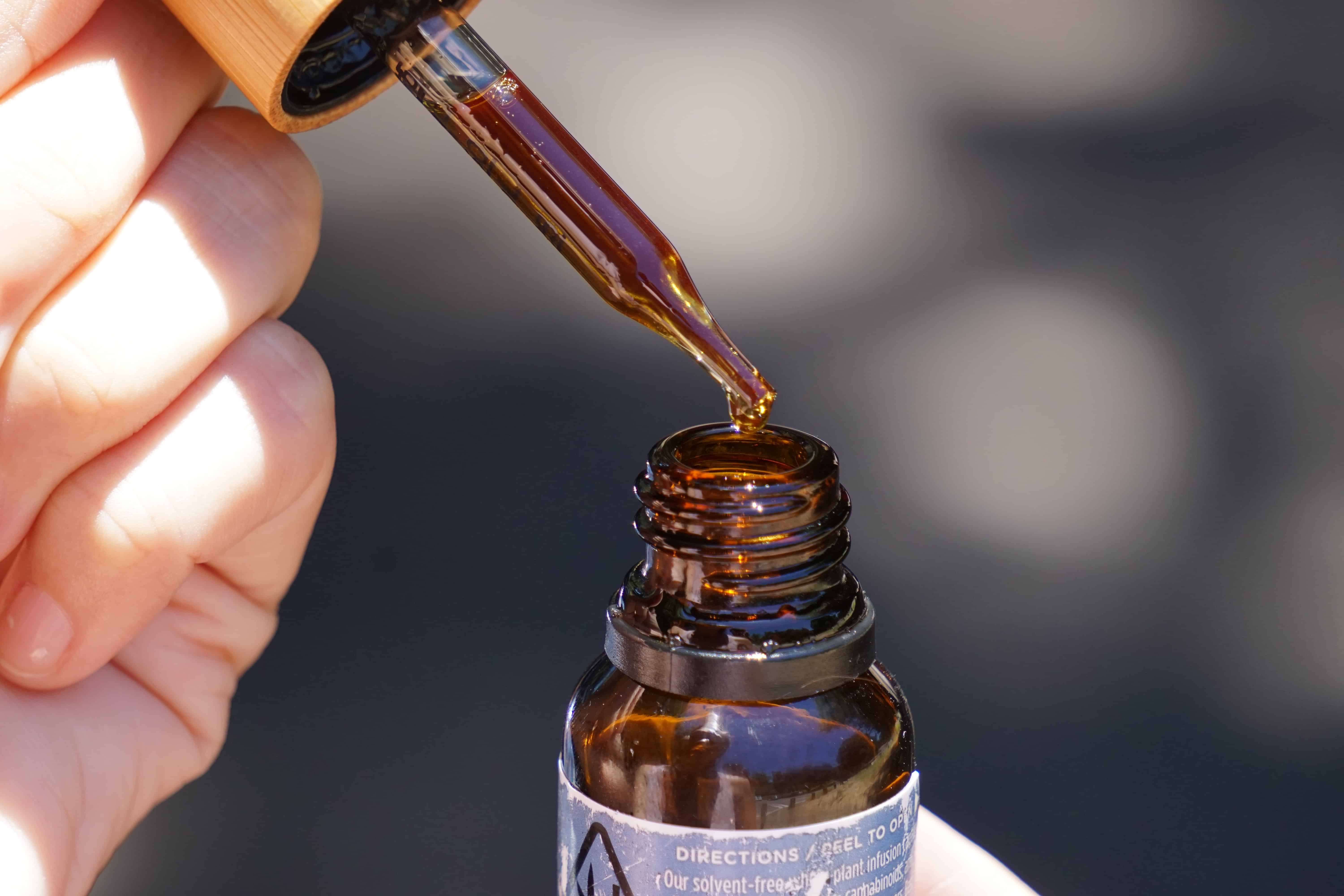
As we know, when it comes to cannabis, red eyes are typically attributed to smoking marijuana. Marijuana is the specific variety of the cannabis plant that contains higher concentrations of THC, which is responsible for producing intoxicating effects on its users.
However, THC doesn’t just get you high, it also directly causes your eyes to become red and in some instances dry.
This is because THC, much like CBD, interacts with the ECS and cell receptors—only it causes a different reaction. The specific reaction we’re talking about is one that mimics anandamide, which is also known as the bliss molecule.
Anandamide is a fatty acid neurotransmitter that binds with the same cell receptors as THC—namely the C1 receptors, which are mostly situated in the brain and the eyes.
Anandamide induces feelings of happiness, calmness, and sometimes excitement. It also dilates the blood vessels, which lowers blood pressure, allowing more blood flow throughout the body and to the eyes.
THC produces those same feelings and effects on blood pressure and circulation, which causes intraocular pressure. That’s why marijuana users’ eyes usually redden after the THC has taken effect.
Since red eyes are directly related to THC, the same thing will happen regardless of whether you consume edibles instead of smoking or vaping. Of course, with edibles, these effects may take longer to crop up since the substance must be digested in order to enter the bloodstream.
Common Questions About CBD and Eyes
CBD may not contribute to eye redness, but it’s still touted as a miracle supplement that can help treat a long laundry list of ailments.
Those ailments usually include everything from arthritis to high blood pressure to neurodegenerative diseases, but rarely include the eyes. You may have heard that THC helps with conditions such as glaucoma, but what about CBD?
Research suggests that CBD may have the potential to actually worsen glaucoma. This primarily has to do with the fact that the cannabinoid triggers an increase in intraocular pressure in glaucoma patients while THC decreases that pressure.
However, there haven’t been any follow-up studies or research to contribute to a definitive answer as to whether CBD will negatively or positively affect the condition.
There’s also no scientific evidence so far that CBD can help with cataracts. Cataracts is a condition that’s linked to oxidative stress and inflammation, and while there is plenty of research on CBD’s antioxidative and anti-inflammatory effects, it’s still unclear as to whether it can help with the condition.
Now we know for certain that the answer to the question does CBD make your eyes red? Is no. Of course, there is somewhat of a gray area as previously mentioned due to an under-regulated market as well as the various underlying conditions an individual may have that affect the eyes.
That’s why it’s essential to only choose CBD products that come from a reputable and transparent source that provides a Certificate of Analysis (COA) on the packaging or openly displays it on the company website.
Additionally, be sure to only purchase CBD that’s grown and manufactured here in the United States to ensure that the product is real and not synthetic and so it can be easily traced back to the source should an issue arise.
Make sure to check back with us frequently for the latest in the world of CBD products and news.
Resources
- https://www.ncbi.nlm.nih.gov/pmc/articles/PMC5470879/
- https://www.jneurology.com/articles/cannabis-and-autoimmunity–the-neurologic-perspective-a-brief-review.html
- https://www.aao.org/eye-health/news/cbd-oil-may-worsen-glaucoma
- https://www.yalemedicine.org/news/cbd-and-lupus
- https://www.sciencedirect.com/topics/neuroscience/anandamide
- https://tanasi.com/blog/does-cbd-make-your-eyes-red/
- https://cheefbotanicals.com/cbd-facts/does-cbd-make-your-eyes-red/#Does_CBD_Make_Your_Eyes_Red
- https://thecannabisradar.com/cbd-make-your-eyes-red/11251/